What the HVAC evaporator does
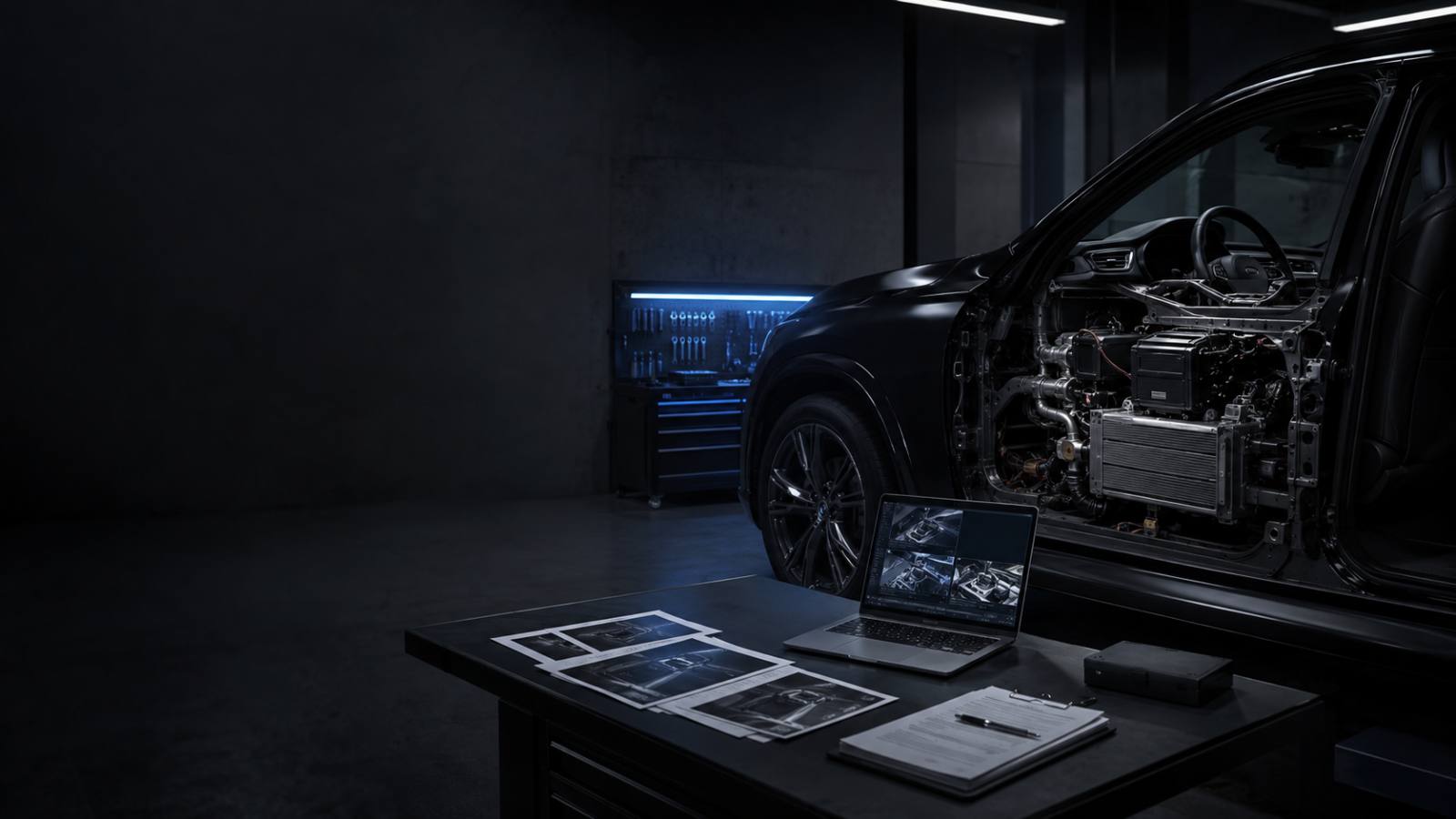
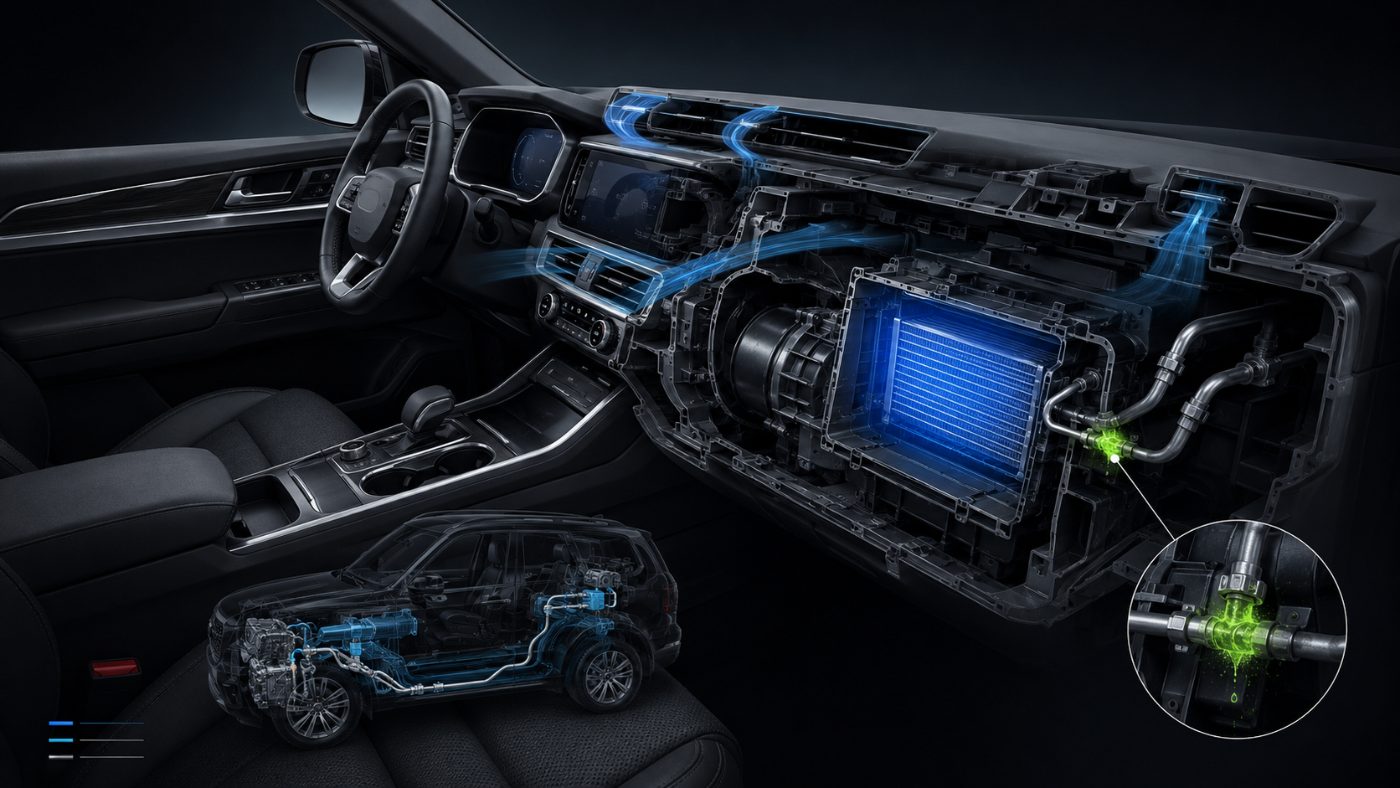
The evaporator is a heat exchanger inside the vehicle’s air-conditioning system. Refrigerant changes state inside the evaporator, absorbing heat from air that is then directed into the passenger cabin. Because the evaporator is typically located deep within the HVAC housing behind the dashboard, access for replacement can require substantial interior disassembly.
An evaporator can be one possible source of refrigerant leakage, but poor cooling does not identify the evaporator by itself. Condensers, lines, fittings, valves, compressors, sensors, actuators and control problems can produce overlapping symptoms. Diagnosis therefore matters more than symptom similarity.
What owners report before diagnosis
Owner reports and forum discussions describe several recurring experiences. These observations are useful for identifying questions to investigate, but none is diagnostic proof of evaporator failure.
One side or zone may feel colder than another. Low refrigerant can contribute to uneven performance, but actuator, sensor, control and airflow problems can create similar symptoms.
Cooling performance may decline over time as refrigerant is lost from any point in the sealed system.
Some owners report restored cooling after refrigerant recharge followed by renewed deterioration. That pattern can support investigation of a leak but does not identify the leak location.
A recovered charge materially below specification can support the conclusion that refrigerant has been lost, but the leak source still requires diagnosis.
Uneven vent temperature, hissing, weak cooling, odor, or temporary post-recharge improvement should not be presented as proof of an evaporator leak.
Why similar symptoms can have different causes
How a suspected refrigerant leak may be documented
Qualified technicians may use multiple methods depending on vehicle design, refrigerant, service history and equipment. Records may include recovered refrigerant quantity, electronic leak detection, UV dye observations where appropriate, system pressure/vacuum testing, component inspection, or other manufacturer or shop procedures.
AutoDefect does not treat a test method name alone as proof. A useful submission identifies who performed the test, what method was used, what result was documented, the vehicle mileage, and what written diagnosis followed.
Why an evaporator repair can cost thousands
The evaporator itself is only one component of the total repair. On vehicles where it is buried within the HVAC housing, the labor required to reach and reinstall the component can dominate the invoice. Interior trim, center-console components, instrument-panel assemblies and other structures may need to be removed and reinstalled before the HVAC housing can be accessed.
AutoDefect separates commercial cost estimators, documented pre-repair estimates, and completed invoices rather than presenting them as one blended national average.
RepairPal currently publishes a BMW X5 evaporator replacement estimate. This is an external commercial estimate, not a BMW dealer quote and not an AutoDefect registry statistic. Actual documented repair estimates can be materially different based on model, location, labor rate, related parts and repair scope.
VIEW BMW X5 EVAPORATOR REPAIR COSTS →Part numbers, fitment and supersession
Parts catalogs can help identify the evaporator listed for particular BMW applications, but fitment should be verified by VIN. Third-party genuine-parts catalogs currently list BMW part number 64119496922 for specified 2019–2020 G05 X5 applications and identify 64115B3A5E0 as a replacement/superseding number.
A superseding part number does not, by itself, establish that the earlier part was defective or that the change was made to correct a failure mode. Fitment and supersession must be verified by VIN.
BMW service information: relevant does not always mean evaporator-related
BMW has issued service information addressing air-conditioning performance problems on various vehicles. Each communication must be evaluated for its exact model, engine, production range, symptom and failure mechanism.
For example, SIB 64 08 21 addresses A/C temperature fluctuation or loss of cooling on specified N63/S63/N74 applications and describes a compressor-control-valve/debris mechanism. It should be presented as an example of an alternative A/C failure mechanism — not as evidence that BMW recognized a G05 evaporator-core defect.
BMW HVAC SERVICE BULLETIN LIBRARY →What NHTSA records can — and cannot — tell us
NHTSA maintains public datasets for owner complaints, recalls, investigations and manufacturer communications. Owner complaints can help identify possible safety trends, but an individual complaint is an allegation submitted to the agency; its presence in the database is not a finding that NHTSA verified the condition or determined that a safety defect exists.
AutoDefect keeps NHTSA records visually separate from AutoDefect document-verified registry cases.
Believe your vehicle condition may present a safety problem? NHTSA provides an official process for consumers to report potential vehicle safety problems at nhtsa.gov/report-a-safety-problem ↗.
Warranty and goodwill outcomes are part of the record
Owners facing out-of-warranty repairs sometimes request discretionary assistance from a manufacturer or dealership. AutoDefect can document whether assistance was requested, the initial and final contribution, dealer participation, escalation path, elapsed time and final owner-paid amount when supporting records are available.
Favorable outcomes must be recorded as faithfully as unfavorable outcomes. A case fully covered by BMW is as relevant to the dataset as a case receiving no assistance.
Manufacturer or dealer goodwill assistance is a consumer-outcome data point. It is not, by itself, an admission of defect, liability, or warranty obligation.
How AutoDefect separates evidence from allegation
Two independent classification systems apply to everything published here. A source class describes where information comes from. A case evidence level describes how well an individual registry case is documented. The two are never interchangeable.
Written diagnosis plus documentation showing evaporator replacement or repair.
Written diagnosis identifies evaporator leakage or failure; repair may be pending.
Multiple consistent indicators and documentation, but no definitive written evaporator diagnosis.
Owner account without sufficient supporting documentation.
Symptoms ultimately attributed to another cause. Preserved, never discarded.
The registry is designed to preserve contradictory evidence. If a vehicle originally suspected of an evaporator leak is later found to have an actuator, condenser, compressor or other cause, the correction remains visible in the record rather than being discarded because it does not support a preferred narrative.
READ FULL METHODOLOGY →Founder case — current documented data
FOUNDER CASE — CURRENT DOCUMENTED DATA. One reviewed record is on file. No aggregate statistic, percentage or failure-rate inference is published from a single case. Additional approved records will appear here with n= labels.
Founder case: the evidence progression from Level B to Level A
This is the same ladder the classification table describes, applied to a real record. Each step adds a specific document. None of them, individually, would have carried the record to Level A.
Progressive loss of cooling, then uneven vent temperatures. Owner-reported: no evidentiary weight on its own.
180 g recovered against a 630 g fill specification. Supports loss; does not identify a source.
Electronic leak detection documented refrigerant traces emerging from the vents — consistent with the evaporator area.
BMW Fresno recommended evaporator replacement in writing. This is what moved the record to Level B.
Evaporator replaced, installed part 64115B3A5E0 identified on the repair order. This is what moved the record to Level A.
System held vacuum, no leaks present, recharged to 630 g R-1234yf.
BMW Fresno documented the A/C system as working as intended — the diagnostic hypothesis closed by repair.
20% BMW NA goodwill on goodwill-level pricing; documented owner responsibility $2,488.34.
A complete, verified repair on one vehicle establishes the dealer’s diagnosis, the repair event, the installed part, the post-repair result and the customer-care outcome. It does not establish why the evaporator leaked, that the component carried a manufacturing or design defect, what BMW knew, or any fleet-wide incidence rate. Evidence quality rose sharply on August 18, 2026. The sample size is still one.
Have a repair order, estimate or invoice? Add the evidence.
AutoDefect is most useful when owners preserve the underlying records. If your BMW has received an evaporator diagnosis, an alternative HVAC diagnosis, a repair estimate, completed repair, warranty determination or goodwill decision, you can contribute the record for review.