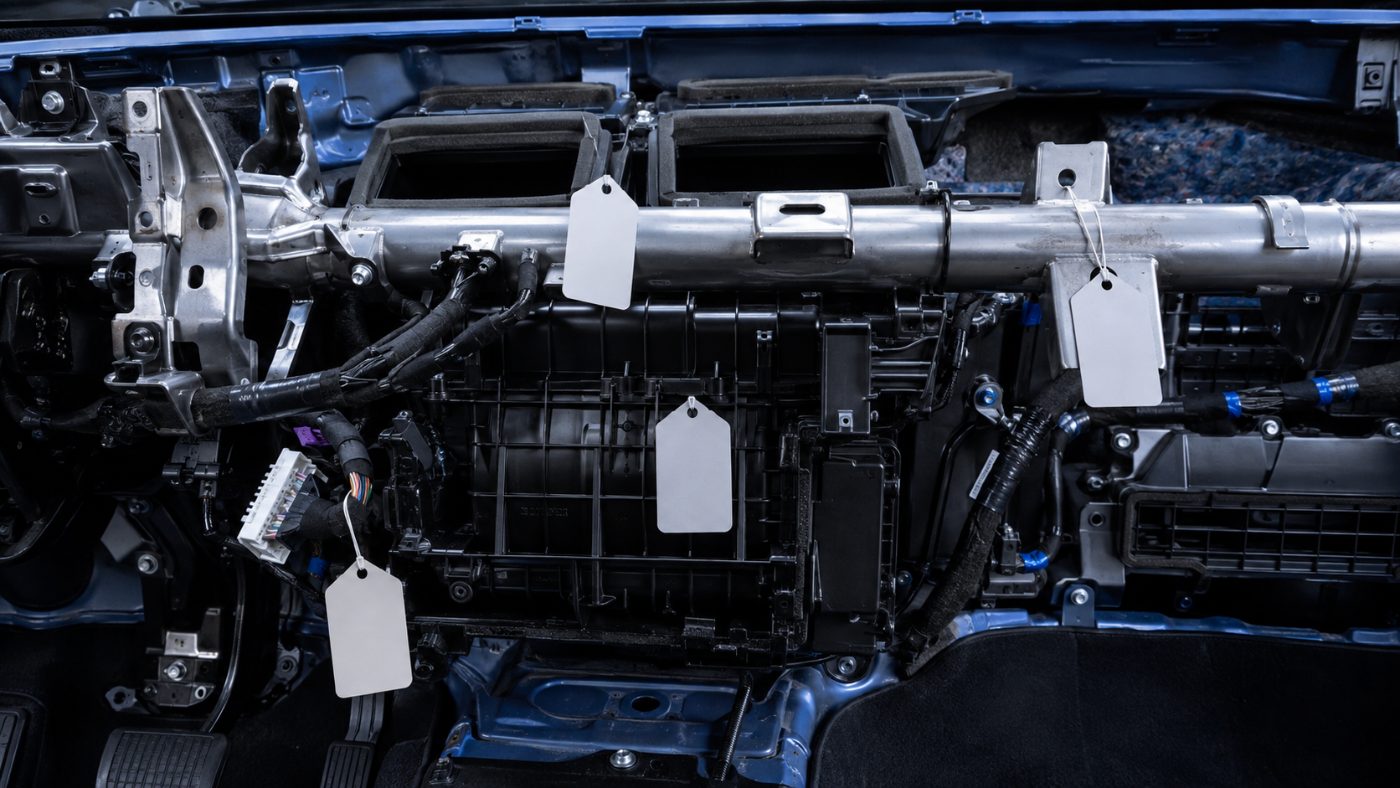
Conditions that can mimic an evaporator leak
A stuck or failed flap actuator can produce a warm zone with a fully charged, leak-free system.
Damaged connectors or harness faults interrupt actuator and sensor operation intermittently.
Synchronization, calibration or control-unit conditions can create zone differences that resolve without parts.
BMW service information (e.g., SIB 64 08 21 for specified N63/S63/N74 applications) describes a control-valve/debris mechanism producing temperature fluctuation or loss of cooling.
A leak at the front-mounted condenser produces the same charge loss as an evaporator leak — at a very different repair cost.
O-rings, crimps and service ports are common, cheaper leak points.
Faulty temperature sensors can drive the system to wrong outputs without any refrigerant problem.
Any written non-evaporator diagnosis is preserved as a Level E record.
Contradiction is part of the evidence
If a case originally suspected of evaporator failure is later attributed to an actuator, condenser, compressor or control fault, the record keeps its full history — original suspicion, subsequent findings, final documented diagnosis. Alternative outcomes calibrate the registry and protect owners from unnecessary dashboard-out repairs.
A registry that records only confirming cases becomes advocacy. A registry that preserves alternative diagnoses becomes evidence.
Was your diagnosis something else entirely?
Level E records — alternative HVAC diagnoses — are as valuable to the evidence base as confirmed evaporator repairs. Submit yours.